Please don’t Delete 2024
Mimmo IANNELLI
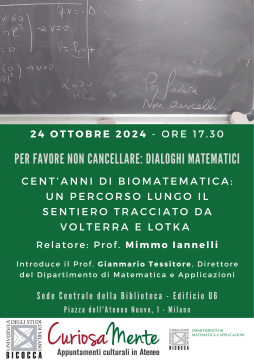
On 24/10/24, the 6th meeting of the cycle Please don’t Delete: Maths Dialogues was held with Prof. Mimmo IANNELLI as speaker.
Title: One hundred years of Biomathematics: a pathway along the path traced by Volterra and Lotka
Abstract: A few years ago, the European Society for Mathematical and Theoretical Biology celebrated 2018 as the centenary of the birth of Biomathematics. At the time, it was decided that the birth of the discipline could be identified with the publication of the monograph ‘On Growth and Form’ by D'Arcy Thompson in 1917. In the essay, biological morphology was discussed on the basis of mathematical transformations. One hundred years since then, the interaction between Mathematics and Biology has undergone such a varied development that it is difficult to say today what Biomathematics is. In this talk I will therefore follow a particular track, which begins with the approach and insights of Volterra and Lotka in the field of Population Dynamics, where Mathematics and Biology interacted successfully and to mutual benefit. For a century, the mathematical approach of Population Dynamics has shaped the development of fields such as Ecology, Epidemiology, Cytology and Immunology. Nowadays, mathematical modelling is the common ground where the joint labours of Mathematics and Biology take place.
The meeting was held at the University Library Headquarters (U6 Building | Piazza dell'Ateneo Nuovo 1, Milano) and was introduced by Prof. Gianmario Tessitore, Director of the Department.
Mimmo Iannelli (Rome, 1946) graduated with a degree in Physics in 1968, he was a CNR researcher at the Institute for Computational Applications in Rome, and later a professor in Rome and Trento. His scientific work focuses on evolution equations and has long been oriented towards the analysis of mathematical models in population theory.
He has participated in various research projects funded by the MIUR and CNR. In particular, he was the national coordinator of the CNR Strategic Project “Mathematical Methods and Models in the Study of Biological Phenomena” (1998–2000), national coordinator of the PRIN project “Mathematical Population Theory: methods, models, comparison with data” (2007), and coordinator of the EPICO project “Epidemics description and control” (2004–2008) funded by the Autonomous Province of Trento.
He has organised schools and conferences, including “Mathematics of Biology” (Cortona 1979), “Mathematical Problems in Environmental Protection and Ecology” (Trento 1991), “Evolution Equation 2000: applications to physics, industry, life sciences and economy” (Trento 2000), “Mathematical Methods and Models in the Study of Biological Phenomena” (Rome 2001), “International Conference on Computational and Mathematical Population Dynamics” (Trento 2004).
He has been a visiting professor at Harvey Mudd College (Claremont, California), the University of Texas at Arlington, Purdue University, Arizona State University, University of Bordeaux II and the CRM centre in Barcelona.
He is the author of various publications on evolution equations and mathematical models in ecology and epidemiology. In particular, the books “Mathematical theory of age-structured population dynamics” (Giardini, Pisa 1995), “Gender-structured population modelling: mathematical methods, numerics and simulations” (SIAM 2005, with M. Martcheva and F. Milner), “An Introduction to Mathematical Biology” (Springer 2014, with A. Pugliese), and “The basic approach to age-structured population dynamics” (Springer 2017, with F. Milner).
Athanase PAPADOPOULOS
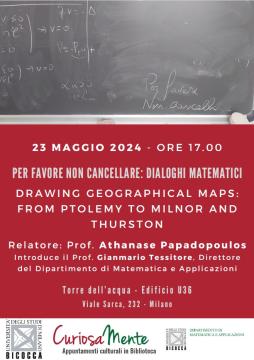
On 23/05/24, the 5th meeting of the cycle Please don’t Delete: Maths Dialogues was held with Prof. Athanase PAPADOPOULOS as speaker.
Title: Drawing Geographical Maps: From Ptolemy to Milnor and Thurston
Abstract: Geographical maps involve many aspects of our lives: art, science, and imagination. We will explain why mathematicians and artists since antiquity were interested in the art of drawing geographical maps. We will also show how several important problems in geometry originate in questions arising from map drawing. We will describe some works on geography by eminent mathematicians such as Ptolemy, Euler, Lagrange, Chebyshev and Milnor. Each of them brought his talent to this beautiful field.
The meeting was held in Room Camatini (U36 Building | Viale Sarca 232, Milano) and was introduced by Prof. Gianmario Tessitore, Director of the Department.
Athanase Papadopoulos is Director of Research at the Institut de Recherche Mathématique Avancée and at the Centre de Recherche et Expérimentation sur l'Acte Artistique in Strasbourg. His main field of research is topology and geometry, and he has also published on the history and philosophy of mathematics, music theory, and the relationship between mathematics and art.
He has taught at various universities around the world, including Brown University, the City University of New York, the University of Southern California, Banaras Hindu University, Tsinghua University in Beijing and others, and has been a research fellow at the Institute for Advanced Study in Princeton, the Max Planck Institute in Bonn, the Erwin Schrödinger Institute in Vienna, the Tata Institute in Mumbai and several other institutions worldwide.
He is the author of over 200 articles and 40 monographs and edited volumes, mainly on mathematics, but also on history, philosophy and music theory.
Frédéric PATRAS
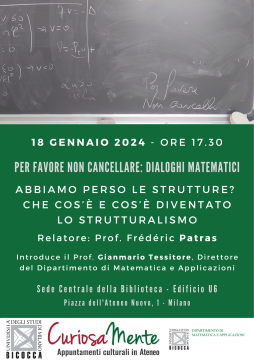
On 18/01/24, the 4th meeting of the cycle Please don’t Delete: Maths Dialogues was held with Prof. Frederic PATRAS as speaker.
Title: Have we lost the structures? What is and what has become structuralism
Abstract: Structuralism was one of the most influential intellectual and scientific movements of the 20th century. This applies to mathematics, but also to the natural sciences, linguistics, economics… and even artistic creation, with Italo Calvino’s (and others’) Oulipo (Ouvroir de littérature potentielle). We will attempt to understand what it was, what it produced (both positive and less convincing), and what it might mean today.
The meeting was held at the University Library Headquarters (U6 Building | Piazza dell'Ateneo Nuovo 1, Milano) and was introduced by Prof. Gianmario Tessitore, Director of the Department.
Frédéric Patras, mathematician and philosopher, is Research Director at the CNRS at the University of Côte d’Azur in Nice. His work focuses on algebra and its various applications, as well as the philosophy of mathematics, within which he has been particularly interested in structuralism and phenomenology.
He has published, in Italian, Il pensiero matematico contemporaneo (Bollati Boringhieri, 2006, paperback edition 2017), and La Possibilité des nombres/The Essence of Numbers (2014, 2020) and, with P. Cartier, Classical Hopf Algebras (2021).