Insalate di Matematica: Special Event!
Cineforum: Picture a Scientist
Department of Mathematics and Applications
The Mathematics beyond the Desks 2023 day was held on 27/04/2023, as part of the events for the 25th anniversary of the University of Milano-Bicocca. Below you will find the flyers, videos of the talks, and photos of the event.
Samples of mathematics
Maths secrets - Ciphering and deciphering messages
An invite to topology - Strings that coil, deform, but don't break!
Probably Strange - How probability theory helps us against misleading intuitions
Let's flatten the Earth - Mysteries and pitfalls in geographical maps
Beziér curves - From points, segments, meshes.... to design and computer graphics
Topology and curvature of polyhedra - A discrete approach to some aspects of surface theory: Euler's constant and Cartesio's lost theorem.
Puzzles and abstract algebra: an unexpected encounter - The algebraic structures behind some classic puzzles, such as the Rubik's cube or the game of 15
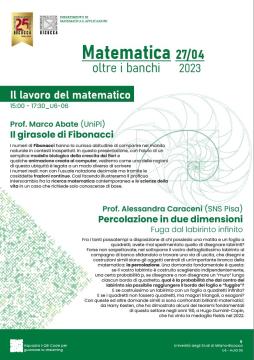
THE MATHEMATICIAN'S WORK
Below the videos of the two conferences on the work of a mathematician:


The Maths beyond the Desks Day 2024 was held on 19/04/2024. The event programme, conference abstracts, flyers and photos can be found below.
Programme:
9 am reception of participants (room U2-08b)
9:30 am team competition and award ceremony (room U2-08b)
12 am lunch (Galleria della Scienza south side)
1 pm maths samples (Science Gallery)
3 pm mathematician's work (room U2-07)
5:30 pm final greetings (room U2-07)
Samples of mathematics
What is studied in a maths degree: previews and information
The Secrets of Mathematics - Ciphering and Deciphering Messages
Probably Strange - How probability theory helps us against misleading intuitions
Let's flatten the Earth - Mysteries and pitfalls in geographical maps
Plane tessellations - From Escher to the Einstein dowel
Floating-point arithmetic - How to kill your friends with a computer code
In search of prime numbers - How many prime numbers there are and how (not) to find them: from Eratosthenes' sieve to Conway's PRIMEGAME.
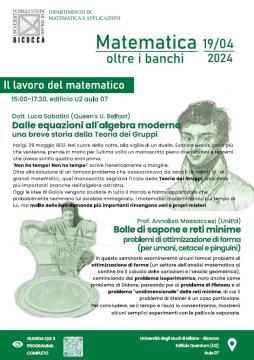
THE MATHEMATICIAN'S WORK
What does a mathematician do for work?
Dr. Luca Sabatini (Queen's U. Belfast) - "From equations to modern algebra: a brief history of Group Theory"
Abstract: Paris, 29 May 1832. In the middle of the night, on the eve of a duel, Évariste Galois, in his early twenties, picks up for the last time a manuscript full of equations and theorems that he had written four years earlier. "I have no time! I have no time!” he writes frantically at the margin. beyond solving a famous problem that has obsessed the minds of great mathematicians for centuries, that manuscript marked the beginning of Group Theory, one of the most important disciplines of abstract algebra. Today, Galois' ideas are studied all over the world, and have applications that even he probably would not have imagined. Modern mathematicians have more time than he did, but many of their most important questions remain mysteries.
Prof. Annalisa Massaccesi (UniPd) - “Soap bubbles and minimal networks: shape optimisation problems (for humans, cetaceans and penguins)”
Abstract: In this seminar we will examine some famous shape optimisation problems (a field of mathematical analysis on the borderline between the calculus of variations and geometric analysis), starting with the isoperimetric problem, also known as Didone's problem, and then moving on to Plateau's problem and the "one-dimensional" problem of minimal networks, of which Steiner's problem is a particular case. If time and the classroom permit, I will show some simple experiments with soapy films.


