Al@Bicocca Seminar: I. Foniqi
Decision problems in one-relator monoids
Department of Mathematics and Applications
As part of the international exchange program, the Department of Mathematics and Applications hosts scholars and academics from Italian and foreign institutions every year, to collaborate on research and teaching projects relevant to the Department's activity.
The list of the visiting scholars with the name of the institution of origin is listed in the attached document.

08/06/26 - 30/06/27
LAOUFI Maël - Université Paris Dauphine, France (PhD)
Departmental Contact: Professor Francesco Caravenna
01/10/26 - 30/11/26
DE FREITAS PESSOA Leandro - Federal University of Piauí, Brasile (Professor)
Departmental Contact: Professor Stefano Pigola
Proposals for visiting candidates must be submitted following the instructions given by the Institutional Regulations (attached here) and forwarded to the attention of the Head of the Department.
Page updated on 04/09/2026
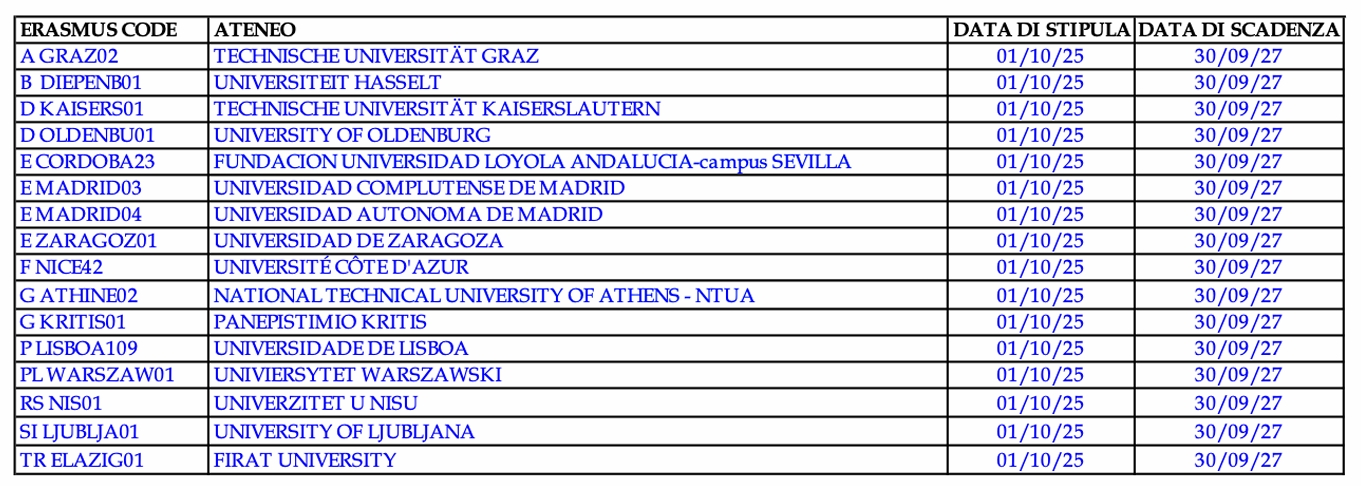
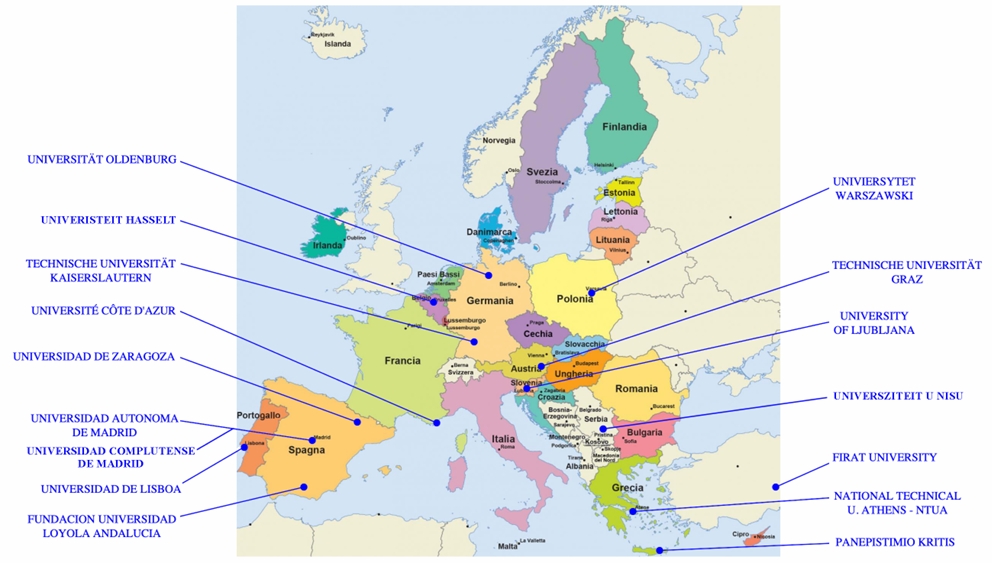
The Bachelor's and Master's Degree programme in Mathematics take part in the Erasmus Study programme (Eramsus+), a resource aimed at promoting cooperation between higher educational institutions in EU countries, through the international mobility of students, faculty and non-teaching staff.
By the Erasmus+ programme the student acquires a study experience abroad at a university institution with which our Department has a signed agreement. The total period allowed for this experience can range from a minimum of 3 months to a maximum of 12 months (possibly spread over distinct periods, over different academic years). The interested applicant must be regularly enrolled in the courses of the approved study plan, and can apply to the Erasmus+ programme proposing the desired institution and visiting period. Normally the call for the Eramsus+ applications takes place during December of each year with outcomes communicated in February. Applicants to the Eramsus+ scholarship will be shortlisted on the basis of academic merit and quality of the submitted proposal. The Erasmus+ scholarship will be increased by an additional amount provide by the University of Milano-Bicocca. Selected participants will be required to submit a Learning Agreement for the proposed visiting period abroad, identifying the examination courses offered by the chosen University and Department. The exams will be taken on site according to local rules, and the results (converted into 30ths) will be formally incorporated into the study plan approved by the Department for the purposes of obtaining the Degree.
Professor Renzo RICCA, (e-mail: renzo.ricca@unimib.it) is the current contact person and coordinator of the Department for carrying out the Erasmus Study programme.
Further information is available at the web address: https://en.unimib.it/international/international-students/outgoing-students/erasmus-study
Courses offered to ERASMUS incoming students can be inspected at this web address: https://en.unimib.it/education/mobility-opportunities/course-catalogue-incoming-students
The Erasmus Traineeship programme is aimed at students regularly enrolled by an approved study plan, who wish to carry out part of their thesis work under the supervision of a joint supervisor abroad, working in an institution that is not necessarily affiliated with our Department by an Erasmus programme, but it is placed in one of the EU member states.
The Erasmus Traineeship call is advertised normally 3 times a year, during February, June and September. It provides scholarships that cover a period of about 2 months, deemed sufficient for carrying out the proposed thesis work. The Traineeship programme is based on a thesis project designed and previously agreed upon by the local supervisor, who will be formally responsible for the progress made in partial fulfilment of the degree.
For further, general information please contact Professor Renzo RICCA, (e-mail: renzo.ricca@unimib.it), who acts as designated Departmental contact for the Erasmus Traineeship programme.
Further information is available at the web address: https://en.unimib.it/international/international-students/outgoing-students/erasmus-traineeship
The Bachelor's and Master's Degree programme in Mathematics take part in the Extra-EU Exchange programme, which allows to spend periods of training and study in foreign institutions that are neither affiliated with the Erasmus programs, nor part of EU membership. Interested applicants must have similar qualifications and must follow similar rules as those required by Erasmus calls, following similar application and selection procedures.
For further, general information please contact Professor Renzo RICCA, (e-mail: renzo.ricca@unimib.it), who acts as designated Departmental contact for carrying out the Extra-EU Exchange programme.
Further information is available at the web address: https://en.unimib.it/international/international-students/outgoing-students/exchange-extra-ue
Page updated on 08/05/2026
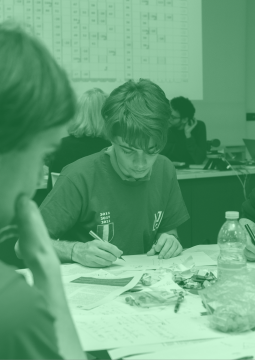
Maths beyond the desks aims to show the non-school aspects of mathematics; a day of competitions, applications and research for high school students, organised by the Department of Mathematics and Applications.
The event is structured in four parts:
Maths Beyond the Desks 2027 - View Italian Page
The Maths beyond the Desks Day 2026 was held on 10/04/2026. The event programme, conference abstracts, flyers and photos can be found below.
Programme:
9 am Welcome of participants
9:30 am-11 am Team Competition: Math Games | Room U2-08b
9:30 am-12:30 pm Math Workshops: Guided explorations of math | Rooms U4-01 and U4-02
12:30 pm-1:30 pm Lunch (Science Gallery)
1:30-3 pm Math Samples (Science Gallery): What You Study in a Mathematics Degree: Previews and Information
3 pm-5 pm The Mathematician's Work: Lectures by Prof. Giada Franz and Prof. Giovanni Paolini | Room U2-06
5 pm Final greetings
THE MATHEMATICIAN'S WORK
Speaker: Prof. Giada Franz (Université Gustave Eiffel, Paris)
Title: Minimal surfaces between classic problems and open questions
Abstract: Many interfaces and membranes in nature tend to minimize their area: this is the case, for example, with soap bubbles or the interfaces between two immiscible fluids at equilibrium.
From a mathematical perspective, these shapes are described by minimal surfaces. Although minimal surfaces are among the most classical objects in mathematics, their study proves surprisingly complex and remains a very active area of research today. In this seminar, we will explore some of the questions that have already been resolved and others that remain open regarding these complex and elegant mathematical objects.
Speaker: Prof. Giovanni Paolini (University of Bologna)
Title: Hidden Symmetries Between Algebra and Combinatorics
Abstract: The most interesting and important theorems in mathematics often reveal unexpected connections between very different concepts. In this seminar, we will start with some counting problems related to Catalan numbers and see that their combinatorics is linked to polynomials arising from the study of symmetries. A series of open problems calls for a purely combinatorial proof of the symmetry of these polynomials.


