Please don’t Delete 2025
Paolo ZELLINI
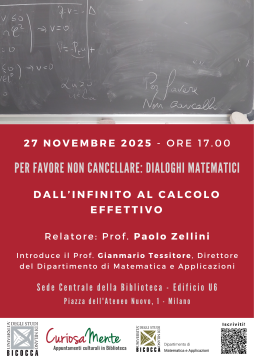
On 27/11/25, the 9th meeting of the cycle Please don’t Delete: Maths Dialogues was held with Prof. Paolo ZELLINI as speaker.
Title: From infinity to actual computation
Abstract: In the last century, the development of automatic computation and the importance of research into the nature of effective procedures for solving large-scale problems stem from the philosophy of the infinite that emerged in the late 19th century, as well as from earlier philosophical trends, particularly in France, regarding the potential convergence of spiritualism and positivism. Among the consequences of this historical juncture are today’s theoretical and practical research on computational efficiency, particularly regarding matrix computation, which is also of crucial importance for machine learning strategies based on neural networks.
The meeting was held at the University Library Headquarters (U6 Building | Piazza dell'Ateneo Nuovo 1, Milano) and was introduced by Prof. Gianmario Tessitore, Director of the Department.
Paolo Zellini is an Italian mathematician and essayist, one of the most original voices in contemporary thinking on the meaning of mathematics. Born in Rome in 1946 and graduating in Mathematics at the Università di Roma La Sapienza, he has carried out research in various Italian and international locations, including Rome, Pisa and the United States. During his career, he has taught at the Universities of Pisa, Udine and finally Rome Tor Vergata, where he is now emeritus professor of numerical analysis.
His scientific contributions concern numerical linear algebra, matrix theory, algorithm complexity and numerical optimisation. Alongside these interests, he has carried out in-depth reflection on the very meaning of mathematical research, placing it in a broader historical and philosophical perspective, attentive to the evolution of ideas.
In his best-known essays, such as Brief History of Infinity and The Mathematics of the Gods and the Algorithms of Men, Zellini has investigated the evolution of mathematical thinking through the concept of infinity and the notion of number, approaching these issues with a perspective that spans not only the history of mathematics but the history of thinking as a whole, even outside the western tradition. In this intellectual path, he recognised the decisive influence of the work of Elémire Zolla.
He is one of the founders of an interdepartmental centre for the study of ancient thinking at the Università di Roma Tor Vergata and regularly collaborates with the cultural pages of various national newspapers. His work combines scientific rigour and philosophical depth in a continuous dialogue between science and humanistic tradition.
Ciro CILIBERTO
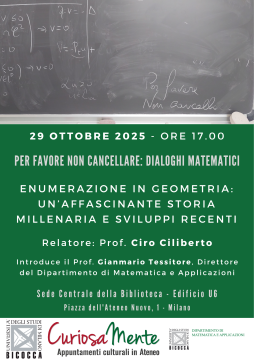
On 29/10/25, the 8th meeting of the cycle Please don’t Delete: Maths Dialogues was held with Prof. Ciro CILIBERTO as speaker.
Title: Enumeration in geometry: a charming millennial history and recent developments
Abstract: The enumeration of geometric objects that verify certain specific properties is an ancient and venerable topic, which began its history more than two thousand years ago with the well-known Apollonius problem. Enumerative geometry is characterised by dealing with problems that are frequently easy to formulate but equally frequently very difficult to solve. In this talk, I aim to examine part of the very interesting and millennial history of this charming topic and its problems. In recent decades, enumerative geometry has seen the rise of new problems, more difficult than the already complex ones of the past, and has undergone a huge change in perspective and spectacular progress, with the introduction of new ideas and extremely refined mathematical tools that have launched unexpected bridges between different parts of mathematics.
The meeting was held at the University Library Headquarters (U6 Building | Piazza dell'Ateneo Nuovo 1, Milano) and was introduced by Prof. Gianmario Tessitore, Director of the Department.
Formerly Professor of Higher Geometry at “Tor Vergata” University, Ciro Ciliberto was born in Naples on 14 October 1950. He graduated in Mathematics from the University of Naples in 1973. Assistant Professor at the University of Naples from 1974 to 1980. Professor of Mathematics at the University of Naples from 1977 to 1978 and of Algebraic Geometry from 1978 to 1980. Extraordinary Professor of Higher Mathematics at the University of Lecce in 1980-1981. Subsequently, he was first extraordinary then full professor of Algebraic Geometry at the University of Naples from 1981 to 1985. Then Professor of Superior Geometry at the University of Rome Tor Vergata. Deputy President of the National Institute of High Mathematics “Francesco Severi” in the years 1990-1995 and member of the Scientific Commission of the same Institute from 1995 to 1999. Director of the Doctorate School in Mathematics at the University of Rome Tor Vergata in the years 1990-1994, and subsequently member of the Scientific Committee of that School. Detached Professor at the "Inter-disciplinary Centre B. Segre" of the Accademia Nazionale dei Lincei in the years 1993-1996. President of the Italian Mathematical Union from 2012 to 2018. Member of the Meetings Committee of the European Mathematical Society since 2013 and President of the aforementioned committee since 2018. Member of the Accademia Nazionale dei Lincei, the Accademia delle Scienze Fisiche e Matematiche in Naples and the Accademia Gioenia in Catania. Website: https://www.mat.uniroma2.it/~cilibert/
Ciliberto is the author of more than 200 scientific publications. His main area of interest is Algebraic Geometry and the history of the discipline. His main research topics are: projective curves; algebraic surfaces; degeneracy techniques and their applications: families of nodal curves, Noether-Lefschetz theory, extensionality problems, Gauss maps, classification of Fano varieties, linear systems of plane curves and nodal curves on K3 surfaces, obstructions to degeneracy; abelian varieties, curves and their moduli spaces; projective-differential geometry of special varieties, focal properties, secant-defective varieties.
Alessandra CARACENI
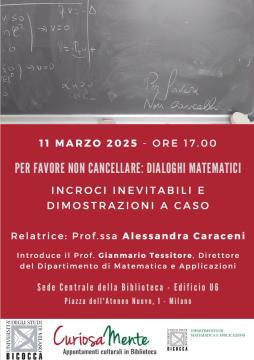
On 11/03/25, the 7th meeting of the cycle Please don’t Delete: Maths Dialogues was held with Prof. Alessandra CARACENI as speaker.
Title: Inevitable crossings and random demonstrations
Abstract: It is 1944; in a labour camp on the outskirts of Budapest, mathematician Pál Turán has the task of transporting bricks from the kilns to the storage areas by loading them into wagons that must then be pushed along tracks by hand. Each kiln is connected by a track to each storage area; running the wagons does not require much effort, except at the junction of two tracks, where they invariably derail and most of the bricks end up on the ground. Pál asks why is the track network built so wastefully, with so many exasperating crossings? How could the number of crossings be minimised, while still connecting each kiln to each storage area? This is perhaps the first question ever asked (still fundamentally open!) about the ‘crossing number’, an important concept in graph theory; in tracing its history and investigating some of its applications we will ‘’cross‘’ constructivist artists, computer scientists, sceptical mathematicians, and finally come across one of the most valuable parts of Pál Erdős' legacy: the so-called Probabilistic Method.
The meeting was held at the University Library Headquarters (U6 Building | Piazza dell'Ateneo Nuovo 1, Milano) and was introduced by Prof. Gianmario Tessitore, Director of the Department.
Alessandra Caraceni is currently a Type B Fixed-Term Researcher (RTdB) at the Scuola Normale Superiore, where she has been working since 2021. Previously, she held the position of INdAM researcher at the same institution, consolidating her commitment to high-level research.
Alessandra’s academic career is characterised by a continuous deepening of her mathematical skills. After obtaining her PhD at the Scuola Normale Superiore in Pisa in 2015 with first-class honours, she went on to undertake prestigious international research experiences. Between 2019 and 2021, she was a Florence Nightingale Fellow at the University of Oxford and Lady Margaret Hall.
Previously, she worked as a postdoctoral researcher at the University of Bath (2016–2019) and held teaching and research positions at Université Paris-Sud – Orsay, both on a full-time (2015–2016) and part-time (2014–2015).
Alessandra attended the Ordinary Course in the Science Class at the Scuola Normale Superiore in Pisa and completed both her Bachelor’s and Master’s Degrees in Mathematics with honors at the University of Pisa.
In addition to research, Alessandra is actively involved in the promotion and education of mathematics. Since 2014, she has been a member of the ‘Olympic Commission’, the Italian national committee for the Maths Olympics. In this context, she regularly gives lectures and seminars aimed to high school students and teachers, covering topics related to teaching and maths competitions.
Her passion for learning and knowledge is also reflected in the field of art: in 2004, she obtained the diploma of “Compimento Medio” in Cello at the Luigi Boccherini Music Institute in Lucca.