Please don’t Delete 2023
Antonio GIORGILLI
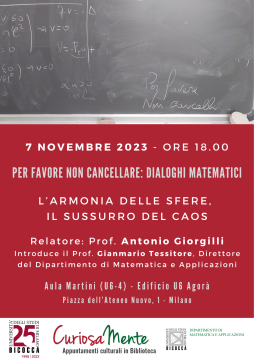
On 07/11/23, the 3rd meeting of the cycle Please don’t Delete: Maths Dialogues was held with Prof. Antonio GIORGILLI as speaker.
Title: The harmony of the spheres, the whisper of chaos
Abstract: Since ancient times, descriptions of the birth and evolution of our world have focused on the concepts of Order and Chaos. The traditional model is based on the idea that planetary motions are perfect, orderly and immutable. This idea has been systematically refuted by reality.
This talk seeks to illustrate how order and chaos are, in fact, inextricably mixed and how complete order and global chaos are just abstract simplifications.
The meeting was held in Room Martini U6-4 (U6 Building | Piazza dell'Ateneo Nuovo 1, Milano) and was introduced by Prof. Gianmario Tessitore, Director of the Department.
Antonio Giorgilli, Professor at the University of Milano-Bicocca and the University of Milano. Member of the Lombardo Institute, Academy of Sciences and Letters. In 1998, he was an Invited Speaker at the International Congress of Mathematicians (ICM98) in Berlin. In 2007, he was awarded the "Gili-Agostinelli" Prize by the Turin Academy of Sciences. In 2009, the asteroid 27855, discovered in 1995, was named Giorgilli.
Research interests: dynamical systems, classical mechanics and celestial mechanics; numerical methods for characterising chaos in dynamics.
Claudio BARTOCCI
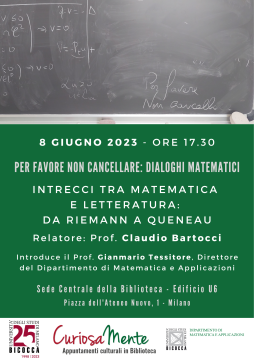
On 08/06/23, the 2nd meeting of the cycle Please don’t Delete: Maths Dialogues was held with Prof. Claudio BARTOCCI as speaker.
Title: From Riemann to Queneau. Interweavings between mathematics and literature
Abstract: Both literary and mathematical creation – both, though in different ways, manifestations of Homo sapiens’ linguistic intelligence – seem to arise from the essential tension that exists between freedom, apparently infinite, of invention, composition, variation and the limitations imposed by formal and structural constraints.
Since the second half of the 19th century, the new universes of non-euclidean geometries, the transfinite hierarchies of set theory, the paradoxes of logic and the abstractions of algebra have opened up boundless spaces to the imagination of writers who have almost nothing in common except a shared sensitivity to the rarefied atmospheres of mathematics: among the most famous, Edwin Abbott, Paul Valéry, Robert Musil, Hermann Broch, Leonardo Sinisgalli, Carlo Emilio Gadda, Raymond Queneau, Georges Perec.
The fictional worlds of literature – we will try to show – are not fundamentally dissimilar to those of mathematics: they offer tools to explore reality and invent other ways of being, to sharpen the intellect and unlock the imagination.
The meeting was held at the University Library Headquarters (U6 Building | Piazza dell'Ateneo Nuovo 1, Milano) and was introduced by Prof. Gianmario Tessitore, Director of the Department.
Claudio Bartocci (Rome, 1962) is an associate professor of Mathematical Physics in the Department of Mathematics at the University of Genova. After graduating in Mathematics, he obtained a PhD in Mathematics (University of Milano, 1990) and a PhD in Mathematics at the University of Warwick (1993). He was a research fellow in Mathematical Physics from 1990 to 1999. In addition to having spent periods of research at universities and institutes such as SISSA (Trieste), the Tata Institute of Fundamental Research (Bombay) the Institut Henri Poincaré (Paris), the University of Salamanca and Boston University, he has also been a visiting professor at the State University of New York at Stony Brook, the University of Paris VII, the University of Pennsylvania (Philadelphia), the École des Hautes Études en Sciences Sociales in Paris and SISSA (Trieste). From 2004 to 2007, he was coordinator of the PhD Programme in Mathematics at the University of Genova.
His research interests focus primarily on methods of differential and algebraic geometry in physical theories. Together with U. Bruzzo and D. Hernández Ruipérez, he has published the monographs The Geometry of Supermanifolds (Kluwer, 1991) and Fourier-Mukai and Nahm Transforms in Geometry and Mathematical Physics (Birkhäuser, 2008, in press), and is the author of some forty research articles in international journals. From 1999 to 2006, he was coordinator of the University of Genova's local unit for the co-funded national project "Algebraically Integrable Systems". He is a member of the editorial board of the journal "Lettera matematica", published by the Pristem centre at Bocconi University.
He also works as a literary consultant and has translated and edited many books, including: A. Weil, Teoria dei numeri (Einaudi, 2002) and Ricordi di apprendistato (Einaudi, 1994), B. Greene, L'universo elegante (Einaudi, 2000) and La trama del cosmo (Einaudi, 2004). He specialises in the history of mathematical thought and the relationship between mathematics and literature, subjects on which he has published various essays. He has edited Henri Poincaré’s collected writings on Geometria e caso: scritti di matematica e fisica (Bollati Boringhieri, 1995) and Scienza e metodo (Einaudi, 1997); together with Giulio Giorello, he edited the volume T. Kuhn, La tensione essenziale e altri saggi (Einaudi, 2006) and contributed the essay “Laicità e ricerca scientifica” nell’opera, edited by Giovanni Boniolo, Laicità (Einaudi, 2006); he published the anthology Racconti matematici (Einaudi, 2006); together with R. Betti, A. Guerraggio and R. Lucchetti, he edited the volume Vite matematiche. Protagonisti del ‘900 da Hilbert a Wiles (Springer-Verlag Italia, 2007). Together with Piergiorgio Odifreddi, he directs Einaudi’s “Grande Opera” La matematica (4 volumes, the first of which, I luoghi e i tempi, was published in 2007). He has contributed to “Le Scienze” and “Il Manifesto”; since 2001, he has been writing for the culture pages of “La Stampa” and “Tuttolibri”.
Lucio RUSSO
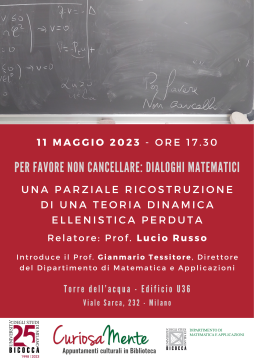
On 11/05/23, the 1st meeting of the cycle Please don’t Delete: Maths Dialogues was held with Prof. Lucio RUSSO as speaker.
Title: A partial reconstruction of a lost Hellenistic dynamic theory
Abstract: Plutarch, in his dialogue “De facie”, mentions a dynamic theory that would be applicable both to astronomy and to the motion of a body free to move within the Earth. A partial reconstruction of the mathematical aspects of the theory is proposed, based on works by various authors.
The meeting was held in Room Camatini (U36 Building | Viale Sarca 232, Milano) and was introduced by Prof. Gianmario Tessitore, Director of the Department.
Lucio Russo (Venice, 1944) studied in Naples, where he obtained his high school diploma and a degree in physics. He has worked in the fields of statistical mechanics, probability theory, the history of science and history. He has taught at the universities of Naples, Modena and Roma Tor Vergata and has spent periods of study at the Institut des Hautes Études Scientifiques (Bures-sur-Yvette, France), Princeton University (New Jersey, USA) and the Laboratoire de Probabilités at the Université Pierre et Marie Curie (Paris, France).
His main achievements in the exact sciences have concerned the rigorous theory of phase transitions, percolation theory and the study of threshold phenomena, while in the field of the history of science he has focused primarily on reconstructing the results of Hellenistic science and their influence on modern science.
His historical contributions are characterised by his approach to historiographical problems, also with the support of methods specific to the exact sciences and sometimes starting from the study of the history of science. He has also spoken on many topics related to cultural policy.
His books include: La rivoluzione dimenticata. Il pensiero scientifico greco e la scienza moderna (Feltrinelli, latest edition 2021, translated into many languages) and Segmenti e bastoncini. Dove sta andando la scuola? (Feltrinelli, 1998); La cultura componibile (Liguori, 2008); and Ingegni minuti. Una storia della scienza in Italia (with Emanuela Santoni, Feltrinelli, 2010, also translated into Chinese), L’America dimenticata. I rapporti tra le civiltà e un errore di Tolomeo (Mondadori Università, 2013, translated into several languages), Stelle, atomi e velieri (Mondadori Università 2015), Flussi e riflussi. Indagine sull’origine di una teoria scientifica (latest edition Mondadori Università, 2020), Perché la cultura classica. La risposta di un non classicista (Mondadori 2018), Archimede. Un grande scienziato antico (Carocci 2019). Notre culture scientifique. Le Monde antique en héritage (Les Belles Lettres, 2020), Il tracollo culturale. La conquista romana del Mediterraneo (146-145 a.C.) (Carocci, 2022).